
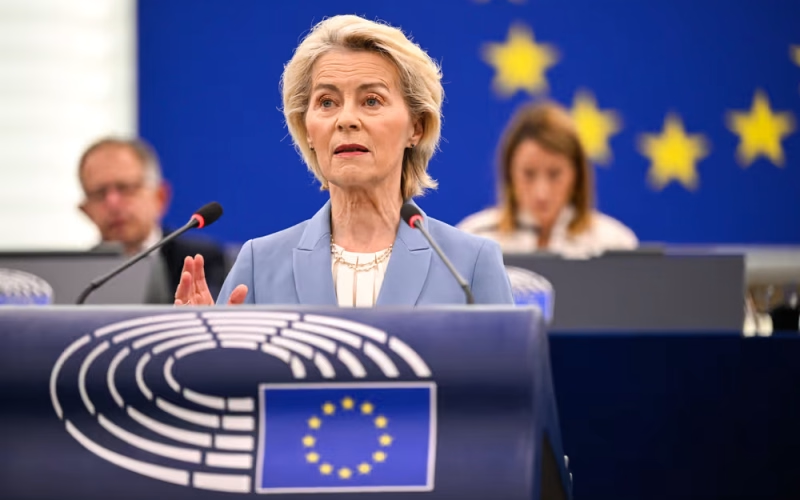
European Commission President Ursula von der Leyen told the European Parliament on Tuesday that Europe must act now to protect households and industry from soaring energy costs, and that the crisis shows why the EU needs an ambitious long-term budget.
Speaking in a plenary debate ahead of the Oct. 15-16 European Council meeting, von der Leyen said gas prices have risen 140% since the end of February and diesel prices have doubled. Imported fossil fuels have cost Europe an extra 100 billion euros “without a single molecule of additional energy,” she said.
“Businesses are under high pressure. People struggle to pay their bills,” she said, warning that the situation could worsen heading into winter.
Lessons from 2022
Von der Leyen said Europe has weathered such a shock before. When Russia tried to blackmail the bloc four years ago, about 45% of EU gas imports came from Russia and nearly all of it was cut off almost overnight. She said Russian gas now accounts for 12% of imports and will be reduced to zero by the end of next year. More than 70% of the EU’s electricity now comes from homegrown, clean sources, including renewables and nuclear, she said.
Short-term measures
Von der Leyen said energy pressures differ across the 27-nation bloc because each member state has a different energy mix. She cited one country where a megawatt-hour of electricity costs about 145 euros because gas sets the price, and another where it costs about 70 euros because nuclear and renewables set the price.
“There is no silver bullet for the whole of the European Union,” she said.
She said the Commission presented a plan called AccelerateEU in April, at the start of the closure of the Strait of Hormuz. It includes a temporary state aid framework for the most exposed industrial sectors, which the Commission will extend, and options to help the neediest households.
Support should be targeted, with no blanket handouts, she said, because those would increase demand, favor higher incomes and carry enormous costs. She pointed to energy voucher schemes for low-income families in France and Romania as good examples.
On the supply side, von der Leyen said Group of Seven members agreed last week to release 100 million barrels of diesel and crude oil to help stabilize global prices. She said the EU will give exporters an additional year of flexibility on methane rules.
The Commission will also launch a strategic dialogue on European refineries, chaired by Commissioners Dan Jørgensen and Andrius Kubilius, to lower costs and secure supplies, including for defense. A new taskforce will bundle energy demand, moving from matchmaking buyers to aggregating demand and tasking a market operator with joint procurement, she said.
Long-term shift
Von der Leyen said Europe’s prosperity will remain exposed as long as it depends on oil and gas. “When we import fossil fuels, we import the shocks and crisis that come with them,” she said.
She said wind and solar produced more electricity than all fossil fuels combined last year for the first time. The EU installed more than 80 gigawatts of renewable capacity last year, she said, but six times that amount is still waiting to be connected to the grid. She urged Parliament to agree on the Commission’s grids package by the end of the year.
Electricity makes up less than a quarter of the EU’s final energy consumption, she said. The Commission’s Electrification Action Plan sets targets to double that share by 2040, which she said could cut fossil fuel imports by 260 billion euros a year. She said the Commission will propose measures in the coming months.
Budget appeal
Von der Leyen said the energy crisis is another reminder that the EU’s next long-term budget must meet the challenges Europe faces. She listed priorities including defense and security, competitiveness, artificial intelligence, energy infrastructure, raw materials, research, skills, enlargement and international partnerships.
She said the Commission’s proposal for the next multiannual financial framework preserves current funding levels for agriculture and cohesion while significantly boosting areas she said are underfunded. It also increases money for crises, including an agricultural reserve and a natural disaster fund that she said are both completely depleted, and for tackling illegal migration.
Von der Leyen said the proposal amounts to 1.26% of the EU’s gross national income. She acknowledged the difficult budget situations in member states but cautioned against large cuts, which she said would cut deeply into agreed priorities. She said the Commission has proposed a significant package of new own resources and expressed confidence that Parliament would back it.
“If we want to preserve our priorities and the level of ambition we have for Europe, we have to do the hard work on the revenue side,” she said.
