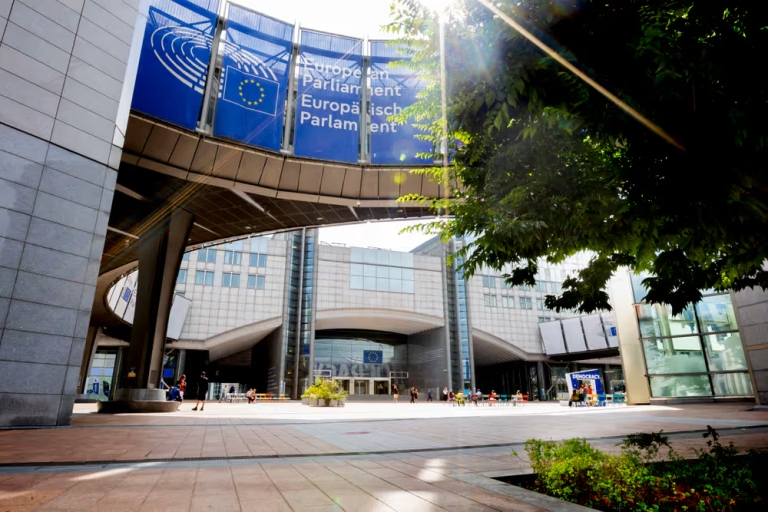
European Parliament would back UK return to EU, senior MEP says as Burnham reopens Brexit debate

The European Parliament would back the United Kingdom re-entering the European Union, a senior member of the assembly said ahead of a major speech by Prime Minister Andy Burnham on Britain’s future relationship with Europe.
Sandro Gozi, chair of the EU delegation to the UK parliament, told POLITICO that a majority of MEPs would be in favor. He said the European Parliament “is the institution which is the most advanced in pushing for a new kind of relationship.”
He said this is the case “across the political groups” because “even the extreme right must take stock of the fact that it [Brexit] was a bad decision.”
Gozi, who is visiting London to attend an annual summit of British and EU lawmakers, welcomed Burnham’s decision to reopen the debate over Brexit. He described the UK’s departure from the bloc as a “disaster.”
He said a UK return to the EU would be “a victory of the progressive forces against nationalism,” finding expression in National Rally in France and the AfD in Germany. It would show that “the future is not going back to nationalistic borders, but building up a future together,” he added.
Questions over Labour’s “red lines”
Marsha de Cordova, chair of the UK delegation to the European Parliament, hailed Friday’s EU-UK summit as “the first step” towards finding a way forward in Britain’s relationship with the EU.
She shrugged off criticism that Burnham has opened up new splits in the Labour Party and the Cabinet. She said that while some Labour MPs have “sensitivities” about moving closer to the EU, “the prime minister and the foreign secretary are right to want to seek to have that conversation and that dialogue and debate.”
“I welcome it because the evidence is there,” she added. “We didn’t have the evidence six years ago, or even 10 years ago. But now we do have the evidence. We’ve seen what happens.”
Both politicians were skeptical of the value of the Labour Party’s “red lines”. Introduced in the 2024 election manifesto, these rule out rejoining the EU, the single market, the customs union or restoring freedom of movement. Burnham has signaled he is not yet ready to tear them up.
“The red lines are being swept away by the debate,” said Gozi. “For me, they are not there anymore.”
De Cordova noted the red lines were drawn up “at a very, very different time… naturally, you need to revisit those at some point.”
Burnham, who started a debate about the EU in his party conference speech in September, spoke at the Lord Mayor’s Banquet on Monday. He said the UK has lost more than it has gained from leaving the EU. He compared the Brexit deal to the “emperor’s new clothes” and said “a needlessly hard Brexit” created barriers for businesses and that the promise to “take back control” was not delivered.
“The Brexit we were given has not worked. We have lost more than we have gained,” he said.
In his first major speech on foreign policy, he reiterated his commitment to Labour’s red lines for the time being, as a sign of a more gradual approach. He said that after the summit he would begin new discussions with the EU about options for “our long-term relationship.” He warned it would take time and insisted that “at every stage the British people will be the boss.”
Burnham has ruled out major changes before the next general election.
He set out three tests for any agreement: that it be consistent with Labour’s 2024 manifesto pledge of “no return to the single market, the customs union, or freedom of movement”; that it improve the original Brexit deal and bring it closer to what people thought they were voting for in 2016; and that it pass the “Makerfield test” of providing tangible improvements to people’s everyday lives, a reference to voters in his Greater Manchester constituency.
Burnham said the prospect of a new deal is a “win-win” and illustrates a “new approach.” He said it should be “not adversarial. No longer burning bridges. But being constructive and positive – showing that we can come together to confront shared challenges.”
He said “Britain was back in the game in a big way” and would be a country that “leads with its values.”
He is due to sign new agreements on food, energy and youth mobility with the bloc at Friday’s summit in Brussels, after the substance of those deals was set by his predecessor Sir Keir Starmer. The two sides are aiming to land a series of deals on agri-food, youth mobility and electricity trading.
The Conservatives have said Labour are “dragging us into the European Union via the back door.”