
The European Parliament is stepping up pressure for stronger, EU-wide protections for children online, warning that the digital environment has evolved faster than the safeguards designed to protect minors. With new data showing children’s increasing exposure to online risks, and platforms still relying heavily on design features that maximise engagement rather than wellbeing, MEPs in the Internal Market and Consumer Protection Committee (IMCO) have now adopted a comprehensive report calling for decisive action.
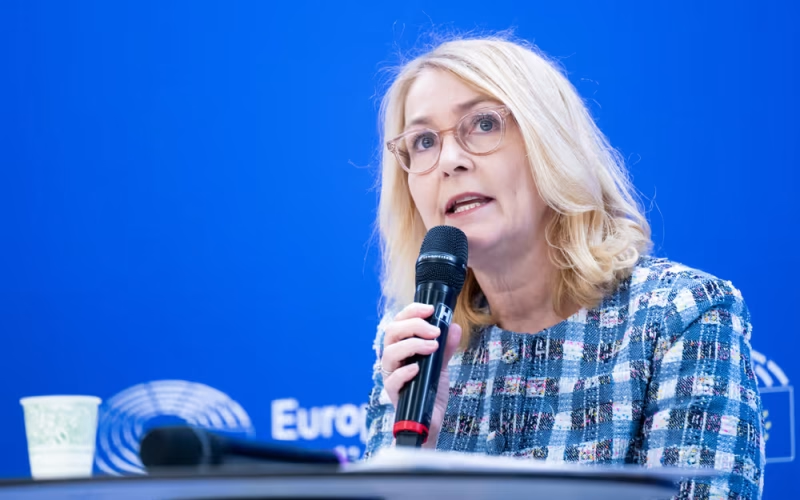
For Socialist MEP Christel Schaldemose, the report’s rapporteur, the debate hinges on two concepts: fairness and responsibility. As she put it during a press briefing with journalists and content creators, social media platforms are built to keep users hooked.
Children, she warned, face “manipulative designs… with algorithms… rewarding them for staying online,” a reality that tilts the digital playing field against young users whose cognitive defences are still developing. For her, this is not simply a matter of parental supervision; it is one of systemic accountability. Protecting children, she argued, “must move beyond good intentions to become enforceable law.”
The IMCO committee’s concerns are backed by extensive research. According to the EU Kids Online survey, one in ten children aged 9 to 16 experiences cyberbullying every month, while many report exposure to harmful content ranging from disinformation to sexual exploitation. The European Parliamentary Research Service notes that over half of young people globally have faced some form of sexual harm online, with the rise of generative AI enabling new forms of grooming, deepfakes and image manipulation. Despite this, national enforcement of existing EU rules remains uneven, and major platforms have repeatedly failed to implement adequate safeguards.
The committee’s newly adopted report, passed with 32 votes in favour, 5 against and 9 abstentions—calls for a rapid and forceful enforcement of the Digital Services Act (DSA), including fines or, if necessary, bans on non-compliant platforms that endanger minors. MEPs stress that the DSA must be fully applied to harmful practices such as addictive design features and gambling-like game mechanisms, which they argue continue to expose children to manipulation, excessive screen time and psychological pressure.
A key plank of the report is the call for a common EU-wide digital minimum age. The proposal suggests a minimum of 16 years for social media, video-sharing platforms and AI companions, unless parents authorise access, and establishes 13 as the absolute minimum age for social media. Schaldemose, who hails from Denmark, supports this direction, noting that while “13 years is an indication,” proper verification is essential, and “between 13 and 16 there should be parental consent.” A harmonised EU standard, she says, is far more effective than “many different” national rules that children can easily circumvent.
Beyond age limits, MEPs want sweeping restrictions on some of the most harmful design features. Their recommendations include banning engagement-based recommender algorithms for minors, disabling addictive features such as infinite scrolling and autoplay by default, outlawing loot boxes, preventing platforms from monetising kidfluencing, and addressing the rise of AI-powered nudity apps that generate manipulated images without consent. MEPs further call for firm enforcement of the AI Act’s provisions on manipulative chatbots.
Schaldemose believes the direction must be clear: “Our report calls for mandatory safety-by-design and for a ban on the most harmful engagement mechanisms for minors.” The goal, she says, is not to restrict young people’s digital opportunities but to provide safe spaces that respect their rights and wellbeing. “We do not want to keep kids away from digital tools, but we need to make sure that when they are online they are safe, and it is simply not the case today.”
The European Parliament will vote on its recommendations to strengthen minors’ online safety during the 24–27 November plenary session, shaping the next phase of EU digital regulation.
Photo: European Parliament

