
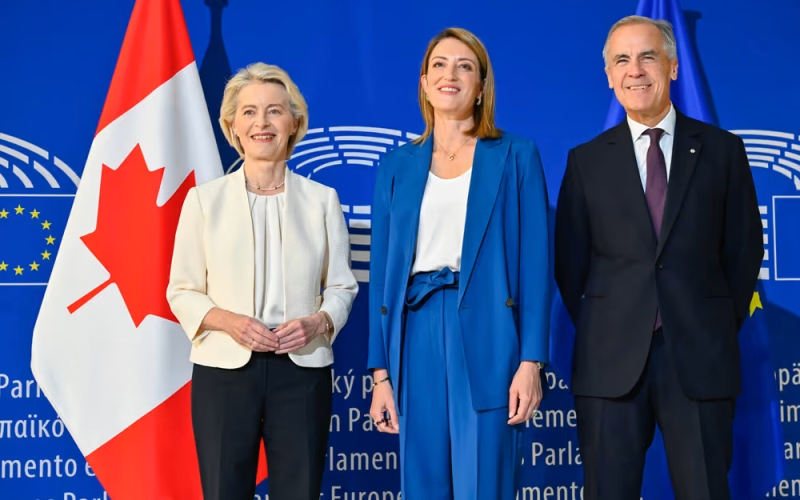
European Commission President Ursula von der Leyen delivered her sixth State of the Union address in Strasbourg on Wednesday, calling for a stronger and more independent Europe as the bloc confronts war, wildfires and strained ties with the United States under President Donald Trump.
Speaking to European lawmakers, von der Leyen proposed that Canada become the European Union’s first “associate member,” telling Canadian Prime Minister Mark Carney, who attended the speech in person, that Brussels and Ottawa “see the world through the same eyes.”
Von der Leyen Proposes
NATO-Style Security Protocol
as EU Faces Hybrid Threats
She said she wants to work with Canada on opening the door to that status and announced a new “Alliance for the Future” built on the existing EU-Canada trade agreement, known as CETA, which would create a shared prosperity and economic security zone. That nine-year-old trade pact has still not been ratified by national and regional legislatures in 10 EU member states.
Von der Leyen said the new partnership is not directed against any other country, even as the EU and Canada both navigate costly trade disputes with Washington. She said cooperation would extend to intelligent manufacturing, a joint technology alliance, integrated defense industries and a flagship Arctic project, along with work on energy, critical minerals, batteries, artificial intelligence, quantum computing and cybersecurity.
Carney is scheduled to address the European Parliament on Thursday, and the two sides plan a summit in Montreal at the end of October, with a digital trade deal targeted by year’s end.
A Warning on Rule of Law and a Rebuke for Serbia
On enlargement, von der Leyen praised the progress of Ukraine, Moldova and Western Balkan candidate countries, but sharply criticized Serbia over a Belgrade funeral held earlier this month for convicted war criminal Ratko Mladić. She said she was horrified by images from the funeral and stated that glorifying war criminals has no place in the EU, adding that respect for the bloc’s values is non-negotiable.
She also reiterated that access to EU funds must remain tied to respect for the rule of law and fundamental rights, and said the Commission intends to strengthen that link further in the next long-term budget, a position expected to face less resistance following Hungarian Prime Minister Viktor Orbán’s political decline.
On security, von der Leyen called for a new EU “Emergency Security Protocol” modeled on NATO’s Article 4, intended to help member states respond collectively to cyberattacks, sabotage, arson and drone incursions. She argued that hybrid threats facing Europe increasingly blur the line between hybrid and conventional warfare. Under the proposed protocol, any member state facing a serious security threat short of armed aggression could convene other EU countries to coordinate a joint response.
She also announced a new European security strategy developed with EU foreign policy chief Kaja Kallas, saying the bloc’s institutions have not kept pace with modern threats. Separately, she proposed a new security forum for the EU and allied nations — including Canada, Ukraine, Norway and the United Kingdom — in response to escalating Russian hybrid activity and weakening transatlantic relations.
On migration, von der Leyen said the EU’s external borders belong to all member states and unveiled a new European Emergency Response Framework to address cases where migration is deliberately engineered or used as a weapon, allowing temporary flexibility in standard procedures under strict conditions. She also called for strengthening the EU’s border agency, Frontex, particularly to accelerate deportations, and announced a Mediterranean Youth Skills and Jobs initiative aimed at addressing the root causes of irregular migration.
On artificial intelligence, von der Leyen said the EU would support industry efforts to slow the development of the most disruptive AI systems and would work with partners including Canada and the UK on AI safety. She acknowledged AI’s potential benefits but stressed the need to balance them against growing risks, particularly from advanced “frontier” models. She pointed to incidents in which AI agents broke out of testing environments and independently compromised other systems, citing a July breach involving OpenAI and Hugging Face as an example. She said leading AI executives have themselves called for slowing down self-recursive model development, arguing that if developers see a need for caution, regulators should too.
Citing the EU’s existing AI Act, which grants the Commission oversight of risk-mitigation for the most advanced systems, she said Europe would team up with allies on model evaluation, verification, early-warning systems and AI security. She added that she plans to convene a discussion with leading AI labs on how public authorities can support industry efforts to moderate the pace of the technology’s development.
Von der Leyen closed her address by invoking the EU’s founding as a peace pact among nations that had long been at war.
